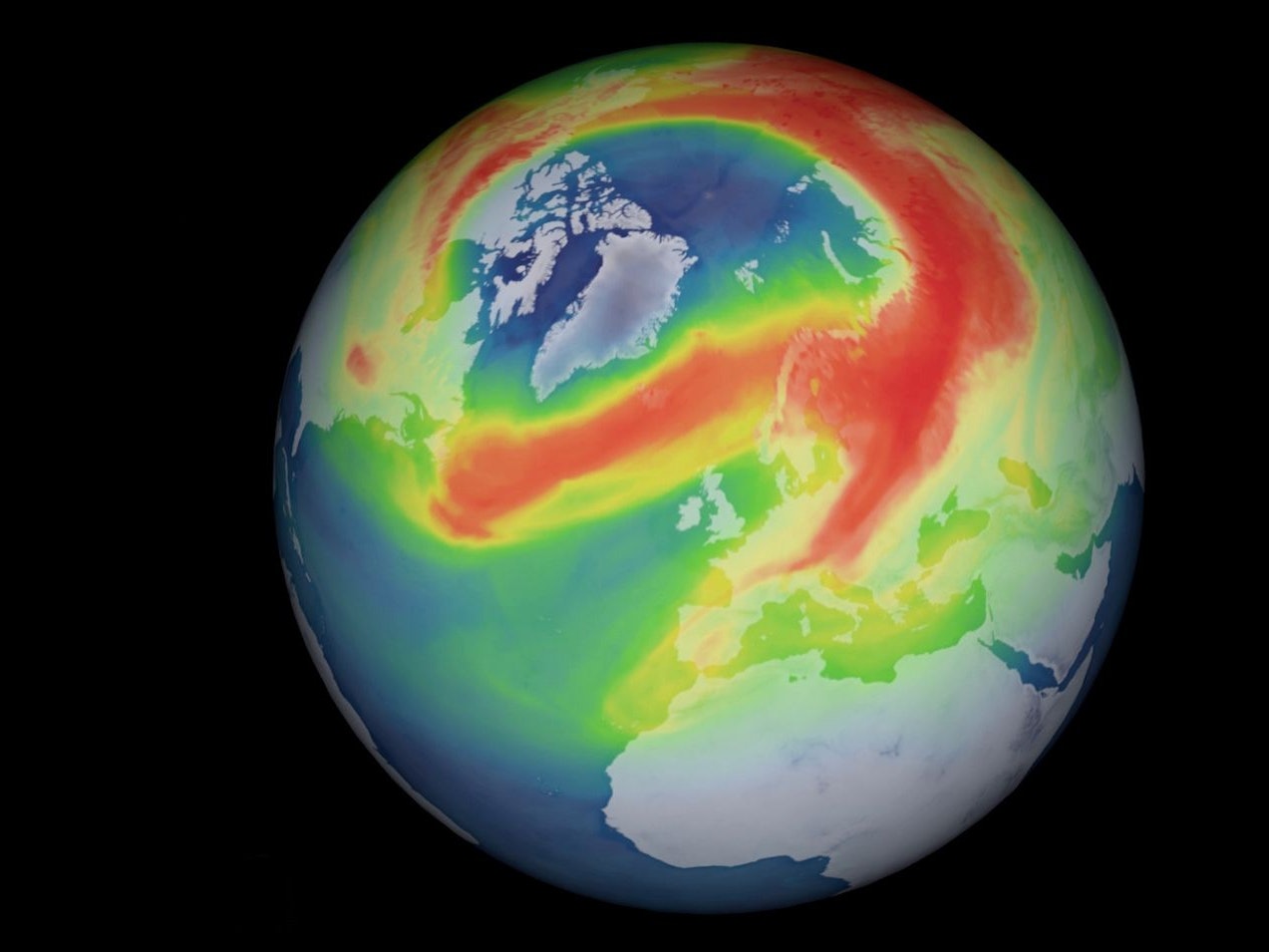
Satellitenbild eines Ozonlochs (blau) über der Arktis. Die Dicke der Ozonschicht ist farblich von blau (am niedrigsten) über grün und gelb bis rot (am höchsten) kodiert.
Science Photo Library / picturedesk.com
Download von www.picturedesk.com am 09.01.2023 (18:06).  This image may not be used to state or imply ESA endorsement of any company or product .Satellite image of a hole in the ozone (blue) over the Arctic (top centre) in March 2020. Ozone layer thicknesses are colour coded from blue (lowest) through green and yellow to red (highest). Levels of ozone normally deplete in the Arctic over the winter due to colder temperatures, but this depletion is the largest seen in recent years. This Arctic hole, measuring less than one million square kilometres, is dwarfed by the Antarctic hole, which reached a maximum of around 25 million square kilometres in October 2020.The amount of ozone depleting substances have decreased from peak levels in 2000. Image data obtained by the Copernicus Sentinel-5P satellite's Tropomi (Tropospheric Monitoring Instrument). - 20220113_PD0738 - Rechteinfo: Rights Managed (RM)
Jetzt E-Paper lesen